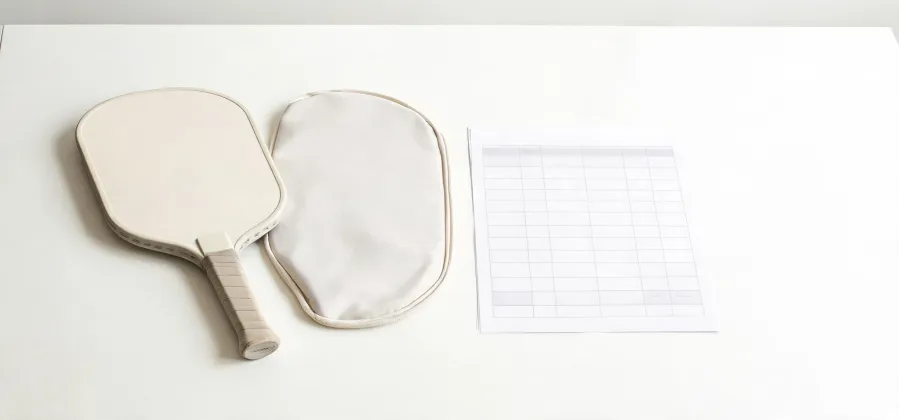
A custom pickleball paddle sample plan should follow the paddle through its lifecycle instead of stopping at an unboxing inspection. The condition that decides how much rigor you need: if the paddle will be sold as USA Pickleball-certified, it has to comply with all certification requirements throughout its entire lifecycle, and production units have to keep matching the certified sample.
For a non-certified custom build, the same lifecycle discipline is a sourcing control, not a certification claim. Nothing here asserts that your paddle, your factory or your model is approved; that status is model-specific and has to be checked against the current record for the exact build you are buying.
A Fresh Custom Paddle Sample Proves Very Little
A sample that passes your incoming checklist proves the factory could build one paddle to your spec on the day that paddle was made. It says nothing about what the same paddle measures after a month of play, and nothing about a later production unit from a different run. The second gap is the one a one-time inspection cannot cover.
USA Pickleball states the concern plainly: with growing concern about paddles improving in performance as they break in, a paddle must comply with all certification requirements throughout its entire lifecycle. That statement has a time axis built into it. A fresh-sample sign-off has one date stamp.
The same framework also imposes a production-consistency duty after certification; I take that up in its own section below. For now, the point is narrower: a one-time check of one fresh unit cannot carry a certified lifecycle claim by itself.
Day 1 Set the Sample Baseline and Hypothesis
Suppose a sample lands on a Tuesday and the supplier's rep wants a go-ahead by Friday. On day one, before anybody hits a ball, I would open a file and put in it the sample ID, the supplier's own spec sheet, the model or mold number, the production date, photos of the face, edge guard and handle, and the starting measurements the supplier itself declares. No invented values: the supplier's declared numbers are the reference you test against later.
The hypothesis I would write down at that point is short. If this sample is built to the approved specification, its measurable condition and its play response should stay within the tolerance the supplier declares after repeated play. That sentence is the test. If you cannot state it, you are not testing anything; you are evaluating a feel.
I would then lock the method. Same measurement points, same ball type, same two hitting partners, same court, same slot in the day, written down so the week-four session is comparable to the day-one session. Paddle friction belongs in that log, since friction is an important part of equipment testing at USA Pickleball, but the number you record is your own baseline, not a threshold you get to set for certification.
First Week Test How the Paddle Breaks In
The first week is where most sample plans quietly fall apart, because the reviewer plays, enjoys it, and calls it good. Suppose instead you run a fixed mix: twenty minutes of wall and feed drills, thirty minutes of dinking, two games, then the same routine on days three and six. Keep the routine boring so the comparison stays honest.
After each session I would log surface condition, sound, feel through the swing, ball response off the face, and friction measured the same way as on day one. The trigger for a lifecycle review is any material change from the baseline, including a change that feels like an improvement. That distinction matters: the lifecycle requirement treats a post-break-in improvement as a change to review, not as a bonus.
A sample that has moved has not failed. It has told you that a single-moment approval was never going to describe it, and that the supplier's tolerance statement now needs to be tested against real drift. I would not stamp pass or fail at this stage; the paddle has not earned either label yet.
Four Weeks Later Re-Measure the Same Sample
In the same hypothetical run, four weeks later I would repeat the day-one measurements with the same instrument and the same ball, then put both sets side by side. The result I would record is whether each reading stayed inside the tolerance the supplier declares, and that comparison is what decides whether your approval file holds up.
If the readings do stay inside tolerance, the next step is production validation: order a pilot run, pull units at the start, middle and end of the run, and compare each one against the approved sample. If they have drifted outside tolerance, or show a clear performance gain tied to break-in, the one-time approval is dead and the sample goes back for root-cause work on mold, core, surface or cure. Both readings are conditional on using the supplier's declared limits and on the paddle being intended for a certification claim.
By the end of the fourth week you are holding a document: dated baselines, dated rechecks, and a stated tolerance the supplier signed. That document is worth more in a supplier conversation than any amount of hitting without a record.
Production Units Must Match the Certified Sample
Certification does not end at sample approval. Once certified, the manufacturer is responsible for ensuring production units continue to meet the same specifications as the original certified samples, and USA Pickleball inspects market samples to confirm compliance. Market-sample inspection is what turns this into a commercial risk rather than a paperwork exercise, because drift can surface after your units are already in the channel.
The sourcing response is to ask for the supplier's production-unit comparison record against the approved sample: which units were pulled, when, what was measured, and how each result compared. Keep your own approved-sample file beside it, with photos, measurements, dated logs and the name of whoever signed. Ask who at the factory owns that comparison and how often it is repeated.
That record does not establish that your custom model is certified. Approval status is model-specific and current, so confirm it separately for the exact build you are buying before any marketing copy uses the word certified.
What Would Make a One-Time Sample Check Enough?
The lifecycle recommendation has an edge. If the paddle will not be sold or described as USA Pickleball-certified, the certification requirement discussed here does not bind it, and what remains is ordinary sourcing consistency: does batch two match the sample you approved. Even then, a one-time check is enough only when three things are true. You have defined the accepted sample in writing, the supplier has agreed in writing to match it, and you accept the risk that break-in or production drift goes undocumented.
Given a US program with retail and league exposure, I would rather fund one extra recheck round at week four than treat an unboxing sign-off as release. That is a spending preference, not a rule: a short promotional run with no performance claim can run a lighter version, provided the file says so.
Conditions that would overturn the lifecycle position: a current model-specific certification record for the exact custom model, plus production-consistency data and sample test records that cover the claimed lifecycle. With those in hand, the lighter plan is defensible. Without them, the position stands.
Lifecycle sampling buys fewer late production surprises and a sample file you can put in front of a buyer, a league or a QA auditor without editing it. It costs calendar time, it costs a second round of measurement, and it will occasionally reject a paddle that felt excellent on day one. For a certified US program, take that trade. For a non-certified build, take the lighter version and label it honestly.
